- Court width
- 432 coordinate units
- Net center
- x=216, half of the court width
- Starting positions
- Left x=36; right x=396
- Scope
- Starting layout in the inspected browser source
The short answer: this browser build has no verified right-side edge
Is the right side better in Pikachu Volleyball? For the current browser build, the source coordinates do not show a built-in right-side advantage. The public game engine defines the court width, puts the net pillar at the midpoint, and starts the two players at mirrored positions. There is no extra strip of court or shorter baseline-to-net distance assigned to the right in that initial layout.
That is a statement about coordinates, not a promise that every match will produce equal wins. A symmetric starting point does not measure serve order, keyboard response, player skill, input timing, collision behavior, or decisions made during a rally. The source positions help rule out one simple explanation, but they do not settle every possible difference in play.
The court coordinates in the published browser source
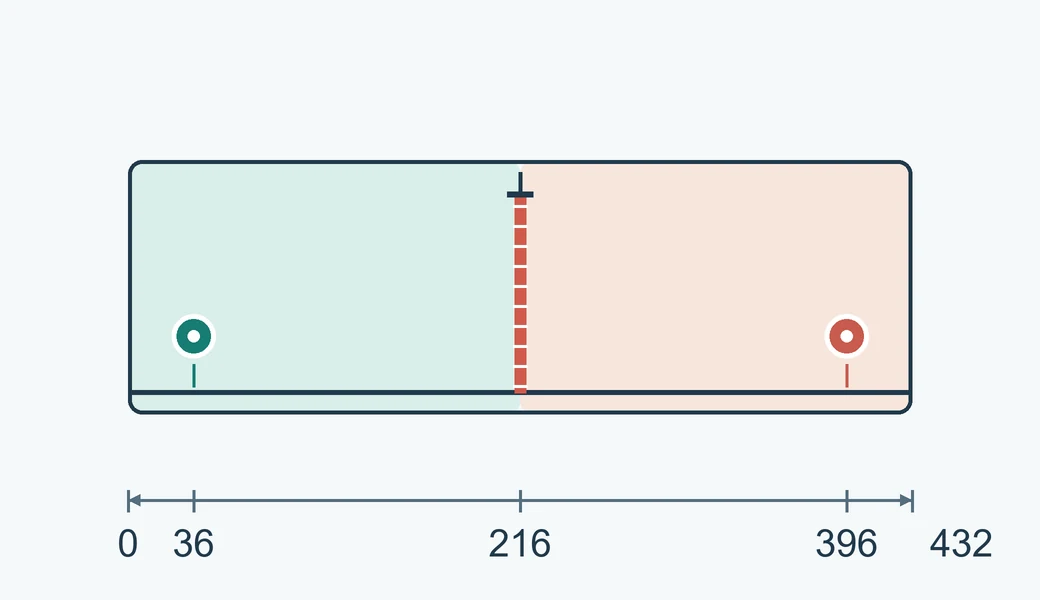
The physics source for this site's browser version defines a horizontal ground width of 432 coordinate units. The net pillar is placed at x=216, exactly half of that width. Player one starts at x=36, while player two starts at x=396, calculated as the court width minus 36. Each starting point is therefore 36 units from its own edge.
The diagram below places those source values on one shared axis. It is an explanatory drawing of horizontal coordinates, not a screenshot, pixel measurement, or reconstruction of the ball's complete movement.
| Element | Coordinate | What it tells us |
|---|---|---|
| Court width | 432 | The reference width for horizontal positions |
| Center net pillar | 216 | Exactly half of 432 |
| Left starting position | 36 | 36 units from the left edge |
| Right starting position | 396 | 432 - 36, or 36 units from the right edge |
What symmetry proves, and what it does not
With a court width of 432 and a net at x=216, each half spans 216 horizontal units. The starts at x=36 and x=396 mirror one another around the center, so the inspected source supports a balanced initial arrangement. It does not show the right player beginning closer to the net or receiving a wider starting area.
Starting coordinates alone cannot prove complete symmetry in every state. Ball velocity, input handling, collision rules, serve transitions, animation, and edge behavior would need separate inspection. The values in this article establish the horizontal starting layout; they are not a published experiment comparing match outcomes.
The source can also change after this article is checked. The numbers apply to the repository file inspected for this page, not automatically to the 1997 Windows original, another fan remake, an emulator, or a modified game mode. If the code or version changes, verify its own coordinates before reusing this conclusion.
- Verified here: the court width is 432 units and the net is centered at x=216.
- Verified here: x=36 and x=396 are equally far from opposite court edges.
- Not established here: equal win rates across all players, settings, and match samples.
- Not established here: identical input, collision, serve, and animation behavior in every version.
Why one side can feel easier even when the starts mirror
A player can make different movements on each side without noticing. The assigned keys may sit differently under the hands, one direction may feel more familiar, or a player may look toward one half of the screen sooner. In a shared-keyboard match, posture and reach can also differ. Those effects come from the control setup rather than the court coordinates.
Serve order can create another false comparison. If the same person starts every rally or one side receives more first serves, the players are not switching under equivalent conditions. A few consecutive wins can also reflect a short run of mistakes, focus, or familiar attack choices rather than a stable property of one half.
Players read an opponent's approach and ball path through experience. A familiar direction may be anticipated earlier; an unfamiliar one can seem faster. These differences can change real outcomes, but the coordinate constants alone cannot identify their cause. Treat them as hypotheses to test, not as evidence that the right court is designed to be stronger.
- Check whether each player uses the same comfortable key group after a side swap.
- Keep the opening serve and target score balanced across both sides.
- Keep speed, screen size, keyboard focus, and device unchanged.
- Record player identity alongside court side so the two effects are not mixed.
A fair side-swap test for two players
Start with one match setup and hold it constant: the same two players, game speed, winning score, device, and screen size. After each game, swap the court positions. If one player stays on the right for the whole test, that player's skill and the right-side effect move together, so the results cannot separate them.
Use an even number of games so both players can spend comparable time on each side. Rotate who serves first as well. Ten games can be a practical first check, but it is not a scientifically established minimum; a longer set is more informative when the outcomes are close. Keep each match under the same rules rather than changing settings halfway through.
After each game, write down the winner, score difference, opening server, side assignment, and any obvious input mistake. Note restarts or changed options separately. Try not to deliberately change attack strategy between sides, while recognizing that people cannot repeat every decision exactly. The aim is a fair comparison, not a laboratory claim.
- Choose the speed and winning score once, then keep both unchanged.
- Swap left and right after every game and rotate the opening serve.
- Record winner, score difference, side assignment, and noticeable input errors.
- Look for a pattern across several swaps instead of naming an advantage after one result.
- Separate games with changed settings or interrupted input from the main comparison.
Read the notes before turning a small sample into a win-rate claim
If one side wins more often in a short set, treat that as a prompt to investigate rather than a verdict. A small number of matches can swing with a few missed returns. One player may have used more familiar keys or been more focused at the time. Scores and recurring situations add context that a simple win count leaves out.
Suppose the same player repeatedly misses short balls from the right. In the next practice set, change one factor at a time: swap keyboard positions, keep the player on the same side, or repeat the same drill. If the misses follow the player's hands, the input setup is a better explanation. If they stay with the court, inspect movement and approach patterns more closely.
| Field | Example | Why it helps |
|---|---|---|
| Court assignment | A left; B right | Connects each result to a side |
| Match setup | Speed, target score, first server | Shows whether the games were comparable |
| Outcome | Winner and score difference | Keeps more context than a win count alone |
| Situation | Late input or repeated miss | Suggests what to check next |
For solo practice, choose repeatable conditions before a favored side
In solo practice, keep game speed and controls fixed while trying both halves. Note missed balls and late turns; if you change the mode or settings, start a separate comparison so the conditions stay clear.
Does the same conclusion apply to the original game or another remake?
The coordinates in this article come from the public physics source for one browser version. They are not a code review of the 1997 Windows original, every site using the same game name, a fork, or a version with changed rules. A remake can alter starting points, movement speed, controls, frame timing, or collision behavior even when the screen looks similar.
Bottom line: mirrored starts are verified; a universal right-side edge is not
The checked browser build has mirrored starts, so no built-in right-side edge is verified. To test a felt advantage, alternate sides and first serve, keep settings fixed, and look for a pattern across several logged matches.